April 8, 2025
Palestine Action in the Crosshairs
“I oppose genocide. I support Palestine Action.”
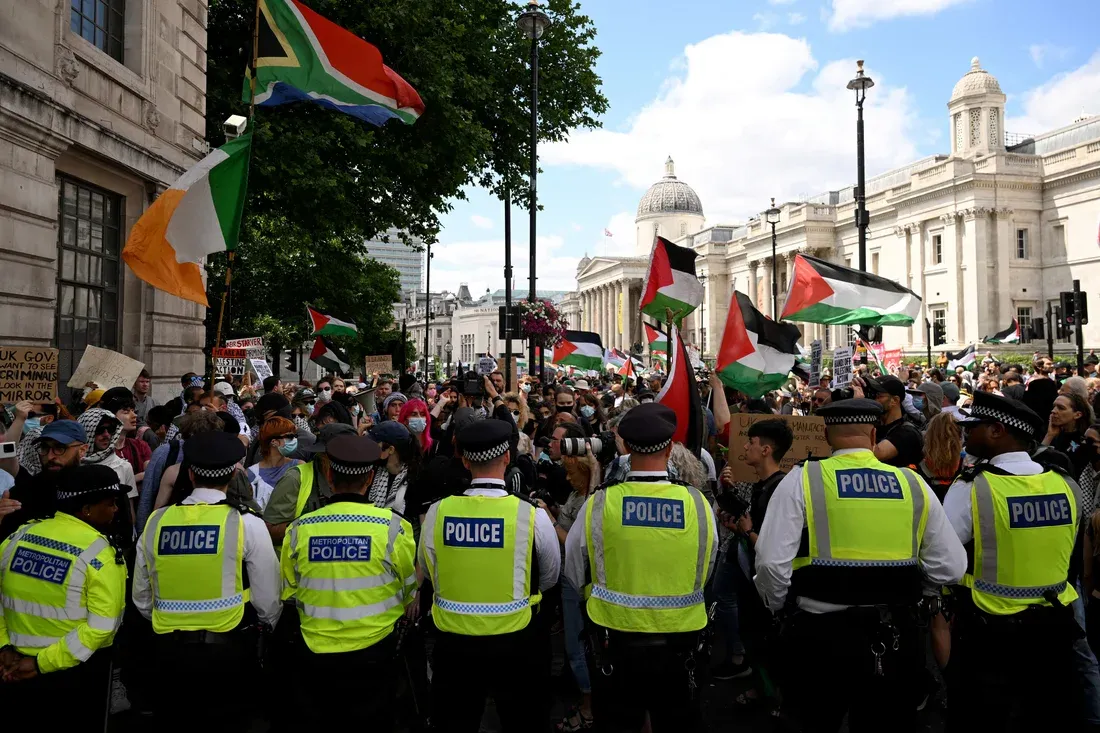
These seven words led to the mass arrest of more than 500 Britons, more than half of whom were 60 or older, on Aug. 9. Just weeks prior, the UK government had swiftly proscribed Palestine Action as a terrorist organization, making membership and declaration of support of the group punishable by up to 14 years in prison.
Palestine Action first emerged in 2020 with the objective of ending corporate enablement of the Israeli military-industrial complex, using an array of disruptive tactics like trespass and vandalism. Early targets of the group included Elbit Systems, an Israeli weapons manufacturer which operated facilities across the UK. After two years of repeated break-ins and property damage at the company’s Oldham location, the facility was shut down in January 2022. After Oct. 7, 2023, Palestine Action escalated its efforts. In June 2025, protesters allegedly stormed the Royal Air Force (RAF) Brize Norton airbase on an e-scooter and sprayed red paint into the engines of two Voyager planes resulting in an estimated £7 million (nearly $9.5 million) in damages. Soon after the disruption, Labour Prime Minister Keir Starmer released a statement on X calling the action “disgraceful.” On June 23, just three days following the Brize Norton action, Home Secretary Yvette Cooper announced to Parliament her decision to designate Palestine Action as a terror group under UK law.
In 2003, the UK government supported its U.S. allies in launching an illegal invasion and occupation of Iraq on dubious grounds. Millions of people around the world gathered in peaceful demonstrations to protest the invasion of Iraq. Nevertheless, the war proceeded, leading to the utter devastation of one of the world’s oldest civilizations and the death of more than 655,000 Iraqis according to a 2006 Lancet study.
Just days before the deadly shock and awe campaign was unleashed upon the city of Baghdad, British protesters broke into the RAF Fairford base in Gloucestershire with plans to block the use of B-52 U.S. Air Force bombers in the looming war on Iraq. Armed with hammers, petrol, dish soap and bolt cutters, the protesters launched separate coordinated missions during which they damaged fuel tankers, instrument panels and cables to obstruct the imminent bombing campaigns. The Fairford Five, as they came to be known, were eventually caught, arrested and tried for criminal trespass in a highly publicized national case, but not before causing an estimated £10,000 ($13,523) worth of damage and significant delays to scheduled military operations.
Their defense hinged on a critical legal argument: the war on Iraq was illegal, and thus all efforts on their part to prevent crimes of war were justified. Through a process of appeals, their cases were eventually escalated to the British High Court, resulting in the retrial and eventual acquittal of some defendants. Among the defense team of the Fairford Five, ironically, was rising human rights lawyer Keir Starmer. He, along with other members of the defense team, argued that the UK government’s contravention of international law in Iraq superseded the criminality of the protesters’ direct action.
In January 2024, the International Court of Justice ruled that Israel’s actions in Gaza could plausibly be seen as genocidal. In November 2024, the International Criminal Court issued arrest warrants for Israeli Prime Minister Binyamin Netanyahu and former Defense Minister Yoav Gallant for their crimes against humanity and war crimes. Despite these rulings, Palestine Action cannot be defended in a court of law after the recent proscription.
Under Section 2 of the Terrorism Act 2000, Palestine Action joins groups like Boko Haram, Islamic State and the Wagner Group as agents of terror. Not only is membership in Palestine Action now punishable under law, expressions of support and calls for deconscription constitute violations as well. Journalists within the UK cannot advocate for Palestine Action or express an opinion or belief that supports the organization. Subjects are also liable if they are “reckless as to whether a person to whom the expression is directed will be encouraged to support a proscribed organization.” Although Palestine Action has not targeted humans with violence, their tactics of property damage, particularly airbase facilities, have been ruled as violations of UK terror law. According to U.N. Human Rights Chief Volker Türk, the new proscription “misuses the gravity and impact of terrorism to expand it beyond those clear boundaries, to encompass further conduct that is already criminal under the law.”
An Israel Lobby Win
Just as the closure of an Elbit Systems factory was celebrated as a victory for Palestine Action, this recent proscription marks a major victory for the Israel lobby, which can still flex its influence over legislative bodies across the West, even though much of the world opposes Israel’s genocidal actions in Gaza.
According to Declassified UK, Israeli weapons manufacturers lobbied the Home Office for the retrial of Palestine Action activists after criminal charges were dismissed against them. Similar cases of pro-Israel lawfare in the United States have resulted in the detention of student activists like Mahmoud Khalil and Rümeysa Öztürk, both of whom were detained at U.S. Immigration and Customs Enforcement facilities under the guise of violating their visas. Despite the growing attempts to criminalize pro-Palestine activism in the United States with punitive anti-Boycott, Divestment and Sanctions legislation, U.S. citizens are afforded Constitutional freedom of speech and protest. This likely explains why foreign students with precarious residence statuses were targeted by the Trump administration. In the UK, no such doctrinally enshrined liberties exist for citizens or visa holders. Under the same Terror Act 2000, British journalists Asa Winstanley and Richard Medhurst were interrogated by police for their coverage of Israel and Gaza. Their homes were raided and their devices seized and investigated. While no formal charges have been brought, the broad parameters of the Terror Act have had a chilling effect on journalists’ ability to write freely and cover ongoing global conflicts.
On Aug. 18, Labour Party leadership from Scotland, Northern Ireland and Wales gathered to call on Keir Starmer to sanction the state of Israel and suspend its military support in an open letter. As global outcry mounted against Israel’s starvation strategy in Gaza, many demanded an immediate ceasefire. Starmer’s response was to instead threaten the Israeli government with British recognition of Palestinian statehood by September should they refuse to end what he referred to as the “appalling situation in Gaza.”
For obvious reasons, the prime minister could not acknowledge Israel’s acts as genocide; to do so would implicate the UK for its complicity in these acts and imposing sanctions would further damn the UK, which aided its allies in committing these acts. In the letter, the group warned the recognition of Palestinian statehood was far too little, far too late. The group openly cautioned that as signatories to the Geneva Convention, the UK had a legal obligation to act against genocide and called on Starmer to “use the UK’s diplomatic influence” to end the starvation blockade. “The UK’s moral standing and commitment to human rights will be measured by its response to this crisis,” they warned in their closing statement.
As global pressure mounts to stop the genocide in Gaza, leaders like Starmer will be forced to contend with their ostensible commitments to law and order and their seemingly boundless support for Israel as it openly commits crimes against humanity. Time is running out in Gaza and real accountability is long overdue.
June 25, 2026
The Pakistan Paradox
From autocracy to geopolitical stardom
April 9, 2026
Israel First, America Last
Trump's war on Iran and the accelerated decline of American Empire
May 17, 2025
Technocracy Simplifies the Business of Genocide
On the fateful union of Big Tech and the Military Industrial Complex
April 2, 2023
Sanctions, Suffering and Syria
How U.S. policy kills in the name of freedom
November 18, 2022
The Neocolonial Energy Crisis
When Europe is in need where does it turn?